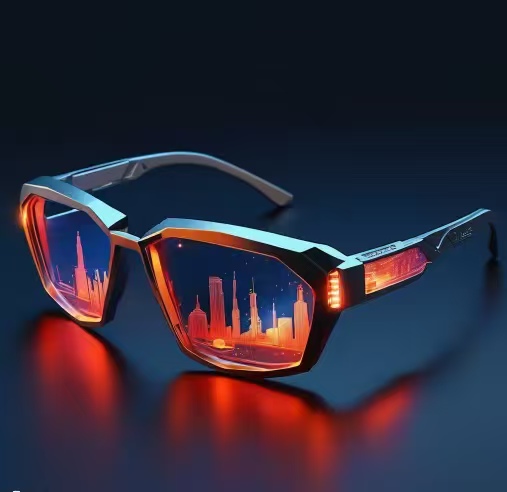
The AI eyewear industry is projected to experience explosive growth in 2025, driven by technological advancements and increasing market demand, transitioning from “minority experimentation” to “mass adoption.” The end-to-end deployment of AI large models—such as GPT-4 and Tongyi Qianwan—enables these devices to offer intelligent functionalities like real-time translation, scene recognition, and health monitoring. Furthermore, breakthroughs in MicroLED display and light waveguide technologies have significantly improved product lightweighting and display quality. Market forecasts indicate that global shipments will reach 12.05 million units in 2025, with audio products experiencing particularly rapid growth (101.9%).
Core advantages:
1. Functional Integration: AI smart eyeglasses integrate capabilities such as AR navigation, industrial maintenance assistance, and medical surgery guidance, enabling hands-free operation and enhancing work efficiency.
2. Interaction Innovation: Multi-modal interaction methods—including voice control, gesture recognition, and eye-tracking—have become mainstream. For instance, Meta Aria Gen 2 supports dynamic health recommendations based on user behavior.
3. Industry Chain Collaboration: China’s supply chain offers notable competitive advantages. Companies such as Leeyou and Lingban Technology are driving the affordability of AI eyeglasses, with models priced below 1,000 yuan becoming increasingly common. Meanwhile, telecom operators and tech giants are accelerating ecosystem development.
Challenges and Bottlenecks:
1. Technical Limitations: Battery life remains a key issue, typically lasting only 6–8 hours. Additionally, the yield rate of light waveguide components is low, and SLAM (Simultaneous Localization and Mapping) accuracy requires further improvement.
2. Privacy Concerns: Built-in cameras and microphones raise data security issues. In response, the European Union has mandated the default disabling of facial recognition features.
3. Ecosystem Fragmentation: The absence of unified technical standards forces developers to adapt applications across multiple platforms, hindering efficient software development and deployment.
Outlook for the Future:
AI eyeglasses are expected to evolve into “enhanced extensions of the human body,” with the global market size projected to surpass 500 billion yuan by 2030, over 30% of which will be accounted for by China.