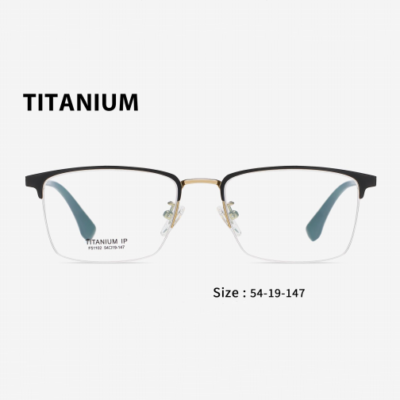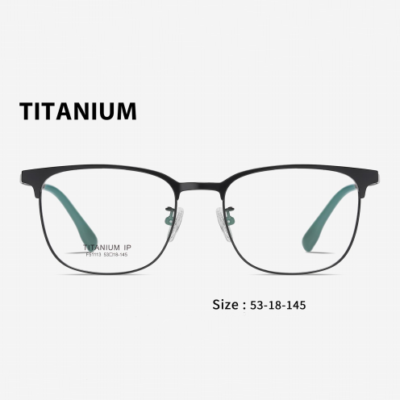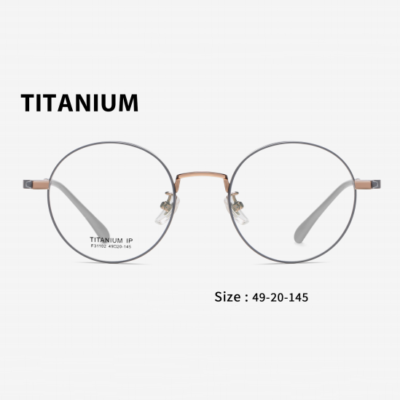

When customers receive a product quotation and inquire about discrepancies between current and previously quoted prices, they may not fully recognize that pricing is influenced by multiple interrelated factors. To illustrate this complexity, consider titanium alloy eyeglasses as a case in point.
1. Material Purity and Pre-Treatment Processes Define Base Cost Variations
The cost differential primarily stems from material purity and pre-processing techniques. For instance, the price of medical-grade pure titanium (Ti-Pure) can be 3 to 5 times higher than that of β-Ti alloy (commonly known as memory titanium). This disparity arises from stringent requirements for purity and processing precision. According to national standard GB/T 3620.1-2016, pure titanium must undergo vacuum melting and purification to achieve a minimum purity of 99.9%. Subsequently, it requires ultrasonic cleaning to remove surface oxides, followed by dehydrogenation at 800°C in a vacuum furnace. Omitting the dehydrogenation step risks hydrogen embrittlement—caused by residual hydrogen atoms—which may lead to frame fracture within 6 to 12 months. In contrast, low-cost alternatives often use recycled titanium scrap with purity below 90%, directly pressed into shape without advanced treatment, resulting in production costs amounting to only one-fourth of those for high-purity materials.
2. Precision Manufacturing Processes Increase Complexity and Add Premiums
The physical characteristics of titanium alloys—such as high strength and poor thermal conductivity—pose significant manufacturing challenges. Producing a single titanium frame involves approximately 80 core processing steps. Five-axis CNC milling operations require precise control of cutting depth down to 0.02 mm (approximately one-third the diameter of a human hair), ensuring curvature and facial fit accuracy within 0.05 mm tolerance. Argon arc welding must be conducted under nitrogen shielding at a tightly controlled temperature of 450°C ± 10°C, producing weld seams no wider than 0.1 mm. Internal weld integrity is verified via X-ray inspection, where any pore exceeding 0.05 mm in diameter constitutes a defect per industry standard GB/T 13678-2019. Compared to conventional sheet metal frames produced through injection molding and basic polishing, titanium frame production takes eight times longer and incurs three times higher equipment wear rates—cutting tools on five-axis machines typically require replacement after every 200 units.
3. Surface Treatments and Functional Integration Enhance Added Value
The durability of titanium frames heavily depends on advanced surface treatments. First, anodic oxidation forms a protective oxide layer 0.5–2 μm thick, enhancing corrosion resistance. This is followed by magnetron sputtering deposition of five nano-scale functional coatings: silicon dioxide for scratch resistance, cerium oxide for anti-fouling properties, and diamond-like carbon to improve hardness. Each coating layer must maintain thickness uniformity within ±15 nm (about 1/5000 the width of a human hair). Conventional electroplating facilities, limited by lower equipment precision, often experience coating delamination, with blistering rates exceeding 15% within six months. Furthermore, integrating intelligent functionalities—such as embedded six-axis sensors for eye posture monitoring—requires over 12 additional processes, including microchip embedding in temple arms, SMT soldering, and circuit encapsulation, significantly increasing per-unit production costs.
In summary, the pricing of titanium alloy eyeglasses reflects a comprehensive integration of material purity, process precision, and functional sophistication. From the purification and dehydrogenation of 99.9% pure titanium, through 0.02 mm machining tolerances, to nanoscale coating controls within 15 nm, each cost component corresponds to “invisible precision.” Consequently, product pricing is determined by a multifaceted array of factors, including raw material quality, labor input, technological investment, and compliance with rigorous manufacturing standards.